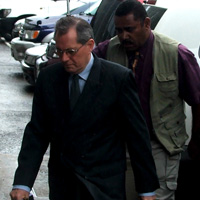
The Prime Minister was today briefed by the Chief Justice Anthony Gates on the treatment of Fiji's judges by the governments of Australia and New Zealand.
Chief Justice Gates met with Commodore Voreqe Bainimarama for about half an hour at the Prime Minister's Office.
Sources have confirmed to us that discussions focused on the case in relation to Justice Anjala Wati whose visa was initially rejected by the New Zealand High Commission.
The issue at hand in this case is the way the New Zealand High Commission treated Justice Wati and her son's case.
According to Chief Justice Gates who has all the documentary evidence of the correspondence, on the 15th of October Justice Wati and her husband lodged an urgent application for a medical visa with the NZ High Commission.
They took this step because their 22 month old child, Katik had been diagnosed with a fully detached retina on his left eye.
The medical report had already stated that urgent surgery is needed overseas as the corrective surgery was not available in Fiji.
Chief Justice Gates has publically maintained that the New Zealand High Commission had rejected the visa for Justice Wati, her husband and their 22 month old child.
He also quoted a letter sent to Justice Wati from an official at the NZ High Commission.
Chief Justice Gates said the NZ High Commission is still trying to maintain that they did not know about Justice Wati's son's medical condition.
It has also been revealed that Chief Justice Gates spoke to Commodore Bainimarama on the Australian government not allowing the transit visa for the judges from Sri Lanka.
Sources also say that the decision now lies with the government on what steps it would take as the actions of Australia and New Zealand have been termed as interference in Fiji's judiciary.
Prime Minister Bainimarama is expected to comment later this afternoon.
Meanwhile, the Australian High Commission in Suva earlier issued a statement saying that they never disallowed the incoming judges from Sri Lanka to transit through Australia to Fiji.
The High Commission states it is not the case that visas were refused to individuals travelling from Sri Lanka to take up judicial positions in Fiji.
The Australian High Commission said in fact, a decision had been made to issue visas to enable the new judges to transit Australia. It reveals that the people concerned withdrew their visa applications after deciding instead to travel to Fiji via Korea.
However, it states that as a courtesy, the Australian High Commission in Colombo advised these individuals that once they took up their positions in Fiji, they would be subject to Australia's travel restrictions policy.