
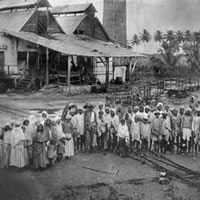
Many Indians who came to work under the Indentured Labour System made their own choices to stay back in Fiji as they were neglected by their loved ones when they returned to India.
77 year old Ram Dayal of Yalalevu in Ba told Fijivillage his father came to Fiji with his parents in 1907 when he was only five years old.
His father used to look after the horses stable in Ba and went to India with his mother in 1918 when he collected enough money.
Dayal said his parents were not allowed to enter their own house by the family members in India and told to sleep under the tree.
His father then caught a train from his village to Calcutta, worked there for a year and then came back to Fiji in 1920.
Meanwhile, a 90 year old farmer of Labasa clearly remembers stories which his grandmother told him about what they went through during the Indentured System.
Kamla Prasad told Fijivillage that his father was 15 years old when he came with his parents to Fiji in the 1880s.
His grandparents and other laborers settled in Labasa at Batinikama lane and used to work in the cane field.
The British overseers used to wake them up at 4am everyday and threatened them with a whip.
And as we celebrate the 130th anniversary of the arrival of the first Indians to Fiji today, it has been revealed that a total of 463 Indentured laborers including 373 males and 149 females arrived in the first lot.
The contracts of the indentured laborers, which they called Girmit, required them to work in Fiji for a period of five years.
In 1882 the Colonial Sugar Refine Company (CSR) from Australia started in Nausori.
It was the same year when Fiji's capital was shifted from Levuka to Suva.
In 1884, the 5th vessel Siria came which ran aground near Naselai in Nausori and 56 people died.
Other people on the ship were rescued by Naselai villages and they took shelter there.
Some of the deceased were buried in Naselai.
Between 1879 to 1960, a total of 89 ships carrying Indians came from India.
In 1920, the Indentured System was abolished and over 25,000 Indians returned to India whereas others stayed back to work in the cane fields.
Girmits celebrate anniversary
Related Stories
COMPOL urges Lagalaga Sanatan students to value discipline and education
Students of Lagalaga Sanatan Primary School in Labasa have been reminded of the importance of education, discipline and obedience by the Commissioner of Police Rusiate Tudravu. Tudravu spoke to the students during

Heavy Rain Alert remains for Viti Levu, Southern Bua, Cakaudrove, Lau and Lomaiviti Groups
A Heavy Rain Alert remains in force for the Eastern half of Viti Levu from Serua, Namosi through Navua, Suva, Nausori, Tailevu, Naitasiri, Ra, Southern Bua, Cakaudrove, Taveuni, Kadavu, Lau and Lomaiviti Groups and near

Warning letter written to Prof. Narsey – Acting AG
Acting Attorney General Siromi Turaga says a strong warning letter has been written to Electoral Reform Commissioner Professor Wadan Narsey after he came out publicly with the Electoral Reform Commission report recommen

3 Fijian men from KVT gang in Sydney denied bail for AUD$12.5M drugs case
Three Fijians who are alleged to be associated with a gang supplying drugs in Sydney have been refused bail by the court. 28-year-old Eparama Nevale, 28-year-old William Ravoka, and 24-year-old George Sukanaivalu,
Proposed ‘People First’ submits application for registration
The Proposed ‘People First’ has submitted its application for registration to the Registrar of Political Parties, Ana Mataiciwa. Mataiciwa confirms that the FEO is now preparing to publish the party’s applica
Visitor arrivals on track for record year while sugar output drops
Visitor arrivals have recovered following a decline in the first quarter and based on current trends, Fiji is on track to achieve a third consecutive year of record visitor arrivals in 2025. While speaking on the p