
The Court of Appeal has granted an appeal to the Republic of Fiji Military Forces after High Court Judge, Justice Jiten Singh in an earlier ruling said that a section of the RFMF Act was unconstitutional.
While delivering the ruling, Justice John Byrne said Justice Singh held that Section 30 of the RFMF Act was unconstitutional in that it did not allow any soldiers convicted by Court Martial to appeal their sentences to the Court of Appeal.
The High Court ruling was made last year after Emosi Qicatabua and seven others, who were convicted and sentenced by court martial for offences relating to the takeover of parliament in May 2000 and mutiny at QEB in November 2000, appealed the sentence.
Following Justice Singh's ruling about the unconstitutionality of the RFMF Act in relation to no appeal of sentences, the RFMF appealed the case giving six grounds.
The RFMF said that Justice Singh erred in failing to give any or any sufficient weight to the fact that those convicted and sentenced in relation to the 2000 coup and mutiny, had been convicted of the most serious military offence the maximum sentence for which is life imprisonment and therefore he should have directed the relevant authorities to make the necessary changes. The military also said to the Appeals Court that Justice Singh failed to take into account or give due consideration to the fact that a court might not be the best forum to determine appeals from General Court Martial because only parliament was the correct forum to overhaul the military justice system in this country. The RFMF further stated grounds that Justice Singh failed to consider and take into account military procedures and customs and the need to have the matter properly debated and scrutinised by legislators.
It further said that the Attorney General or his chambers should make a Presidential Promulgation reflecting the wishes of the counrt as this is the method adopted by the interim government to make laws.
The Appeals Court has ruled based on the RFMF's appeal that it is not for a court to remedy if there is a constitutional dead-end, but for parliament after debate to make the necessary amendments. While delivering the Appeals Court ruling, Justice Byrne said in his judgment it is not an answer to the problem posed in this case to say that if since December 5th, 2006, and for some unknown period into the future there is no parliament then a court may assume the role of parliament in attempting to remedy a situation thought by some people to require a change.
He said it is also important to remember that the soldiers convicted of the 2000 coup and mutiny related charges have been convicted of one of the most serious offences known to the law, mutiny.
Justice Byrne further said that it is no answer to say that because there is presently no parliament, any amendment may be made by promulgation. He said to do so would be merely an act of expediency for which he can find no justification in the law in the present circumstances. The appeal has been granted and there will be orders accordingly.
Court Grants RFMF Appeal

Related Stories

We are committed to holding elections – Siromi Turaga
Questions were raised during Dialogue Fiji’s Constitution review discussion on whether the government can delay the general elections and complete the Constitution review however Acting Attorney General Siromi Turaga

Fijian economy on track to grow for fourth consecutive year in 2025 by 3.4%
The Fijian economy is on track to grow for the fourth consecutive year in 2025 by 3.4 percent, following a 3.5 percent expansion in 2024. The growth forecast is revised up marginally from the 3.2 percent projected

Heavy Rain Alert for Eastern Viti Levu, Southern Bua, Cakaudrove, Taveuni and maritime areas
A heavy rain alert is now in force for the eastern half of Viti Levu (Navua–Suva–Nausori to Serua–Namosi to Tailevu–Naitasiri–Ra areas), southern Bua, Cakaudrove, Taveuni and nearby smaller islands, the Lau an

We need to dismantle criminal enterprises, hitting them where it hurts most - Speaker
Speaker of Parliament, Filimone Jitoko has highlighted during the opening of the Office of the Director of Public Prosecutions Conference that there is a need for prosecutors in the country to master the digital frontie

Fiji has learned from its past and we know that restricting media engagement or access is not the answer - Tabuya
At all times, the public interest in accessing information and the media’s role in scrutinising government must outweigh any unilateral power to silence or sideline a news outlet. In Fiji, we uphold the principle that
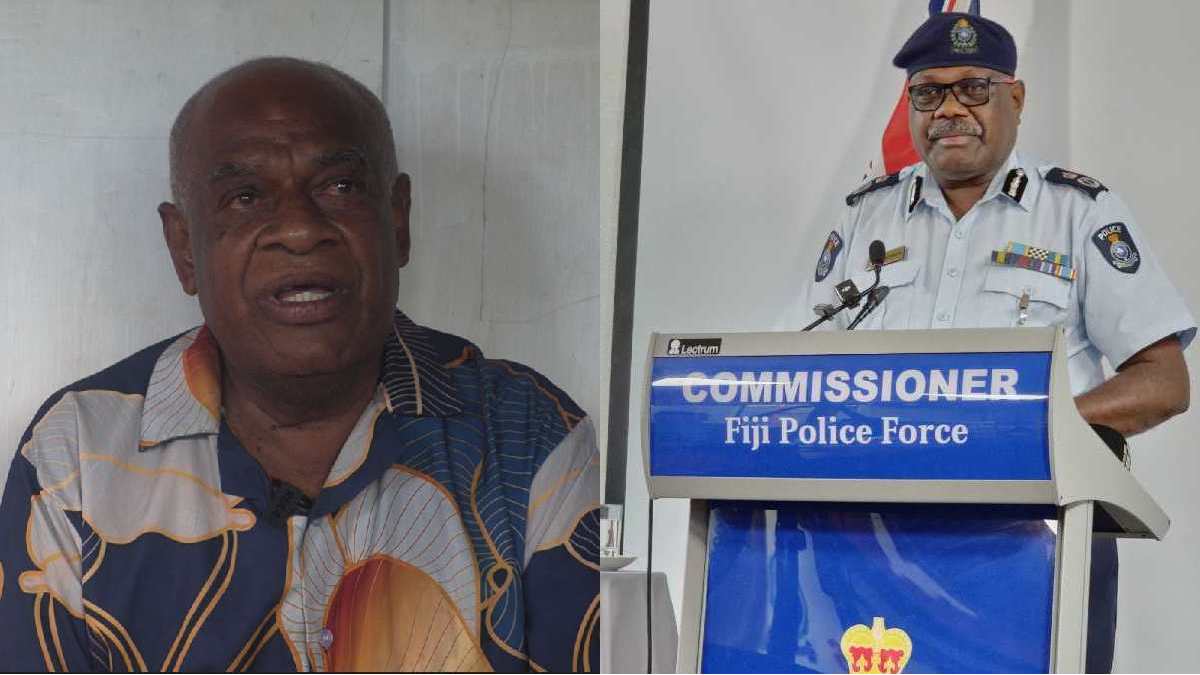
Wailea resident raises concerns about drug issues raised countless times with Police while COMPOL says official complaint must be lodged
Wailea Settlement Community leader, Inoke Utona says he has raised the issue of drug use and dealing in their area countless times with the authorities but there has still been no response from Police. However when