Fiji will have a 50 member Parliament according to the 2013 constitution.
This is up from 45 in the draft document.
Parliament will be the country's supreme authority and be elected on the basis of one person, one vote, one value.
Individual regional constituencies in the draft version have been removed.
The 2013 constitution states that there will be one national constituency which will be the whole of Fiji.
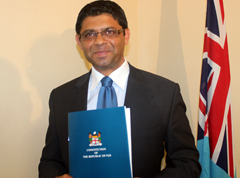
When questioned by Fijivillage, Attorney General, Aiyaz Sayed-Khaiyum said every voter will get one vote, choosing the candidate who they believe best serves their interests under a proportional representation system.
Elections are to be held every four years and every Fijian over the age of 18 is entitled to vote.
A Prime Minister who commands the party with the most seats in Parliament will head the elected Government.
Story by: Vijay Narayan
New constitution made public
The final version of the 2013 Constitution has been made public with some significant amendments that relate to itaukei, Rotuman and Banaban land, the electoral system and the setting up of the Constitutional Offices Commission.
As the fourth constitution was unveiled by the Attorney General, Aiyaz Sayed-Khaiyum earlier today, he said the final version differs from the draft constitution by containing specific provisions that guarantee and strengthen the protection of iTaukei, Rotuman and Banaban lands.
A new section in the 2013 constitution states that the ownership of all iTaukei land shall remain with the customary owners of that land and iTaukei land shall not be permanently alienated, whether by sale, grant, transfer or exchange, except to the state.
It further states that any iTaukei land acquired by the State for a public purpose after the commencement of the Constitution or under any written law shall revert to the customary owners if the land is no longer required by the State.
The same applies for all Rotuman and Banaban land.
Section 30 also states that all minerals in or under any land or water, are owned by the State, provided however, that the owners of any particular land (whether customary or freehold), or of any particular registered customary fishing rights shall be entitled to receive a fair share of royalties or other money paid to the State in relation to the extraction of minerals from that land or the seabed in the area of those fishing rights.
When questioned by Fijivillage on the new sections, Aiyaz Sayed-Khaiyum said the sections have been added to ensure that there is no misunderstanding and people are comfortable with the land ownership clearly stated in the supreme law of the country.
Story by: Vijay Narayan
President to remain Commander in Chief
The President of Fiji will be the Head of State and perform the ceremonial function of Commander in Chief of the Republic of Fiji Military Forces.
This has been clearly stated in the 2013 constitution.
An alteration has been made here compared to the draft version as the previous document had proposed that the Prime Minister should be the Commander in Chief of the RFMF.
Fiji's new constitution also states that the President acts only on the advice of cabinet or a minister or some other body or authority prescribed by the constitution.
Candidates for the Office of the President must be persons who have had a distinguished career in any aspect of national or international life, hold only a Fijian citizenship, not be a member of, or hold any office in, any political party, not hold any public office, not at any time during the 6 years immediately before being nominated, have been convicted of any offence under the law.
The President will be appointed by parliament after a name is nominated by the Prime Minister and another by the Leader of Opposition.
Meanwhile no changes have been made to the section relating to the RFMF.
The 2013 constitution clearly states that it shall be the overall responsibility of the RFMF to ensure at all times the security, defense and wellbeing of Fiji and all Fijians.
The Commander of the RFMF shall be responsible for exercising military executive command of the RFMF.
The RFMF Commander is appointed by the President, on the advice of the Constitutional Offices Commission following consultation with the minister responsible for the RFMF.
Story by: Vijay Narayan
New Constitutional Offices Commission to be established
A new Constitutional Offices Commission will be established under the new constitution.
The commission will consist of the Prime Minister who will be the chairperson, the Leader of the Opposition, the Attorney General, two persons appointed by the President on the advice of the Prime Minister and one person appointed by the President on the advice of the Leader of the Opposition.
According to the 2013 constitution, the commission shall be responsible for providing advice to the President for the appointment of the Chairperson and members of the Human Rights and Anti-Discrimination Commission, the Chairperson and the members of the Electoral Commission, the Supervisor of Elections, Secretary General to Parliament, the Chairperson and the members of the Public Service Commission, Commissioner of Police, Commissioner of the Fiji Corrections Service, Commander of the Republic of Fiji Military Forces, Auditor General and Governor of the Reserve of Bank of Fiji.
Story by: Vijay Narayan
Comulsory teaching of itaukei, Fiji Hindi languages
There will be compulsory teaching of the iTaukei and Fiji Hindi languages at primary school level, along with English as the common language.
This has been enshrined in the new constitution.
Attorney General, Aiyaz Sayed-Khaiyum said this will break down the language barriers and will bring people closer as they will understand each other’s language.
A common and equal citizenry, a secular state which means that the state will not favour one religion over another, elimination of discrimination and social justice remain in the constitution.
The immunity provisions also remain and cannot be revoked, repealed or amended.
President Ratu Epeli Nailatikau will give his assent to the document on September 6th.
It will be the supreme law of the country and pave the way for elections by September 30th 2014.
In the 15 days before the President gives his assent on September 6th, members of the public are invited to read the vernacular versions and provide feedback on their accuracy.
Story by: Vijay Narayan
United Front rejects new constitution
The United Front for a Democratic Fiji which includes the Fiji Labour Party, Social Democratic and Liberal Party and National Federation Party has rejected the new constitution and did not attend the Attorney General's constitution briefing.
According to United Front's spokesperson, Mick Beddoes, the briefing will be nothing more than a lecture by the Attorney General on the vernacular with no opportunity for political parties and other interest groups or the people of Fiji to discuss and debate the document before it is imposed.
Beddoes said they reject the new constitution although they have not read the document.
Beddoes added that the United Front leaders are meeting this week to complete their own roadmap to democracy which will be published.
The United Front also stressed that the President has no legal mandate to assent to the new constitution and without the full participation of the people in the preparation and finalization of the constitution.
The People's Democratic Party also did not attend the briefing.
When contacted, spokesperson Nirmal Singh said he thinks no one was available from the party to attend.
Singh said the party will meet tomorrow and then comment on the constitution.
Meanwhile Attorney General, Aiyaz Sayed-Khaiyum said it is a pity that none of the parties attended the briefing.
Story by: Vijay Narayan and Rusiate Baleilevuka
People of Fiji do not own the new constitution-Yabaki
The Citizen's Constitutional Forum reiterates that the new constitution cannot be considered a constitution by the people of Fiji following the discarding of the draft constitution prepared by the Yash Ghai led commission.
CEO Reverend Akuila Yabaki stressed that it is vital that this constitution be thoroughly scrutinized to ensure that the various provisions adhere to the universal best practices in terms of clear separation of powers between the three arms of Government: the Executive, the Legislature and the Judiciary.
Reverend Yabaki said the people of Fiji do not own the new constitution.
He said CCF intends to provide a comparative analysis between the Yash Ghai Commission Draft, the Government Draft and the final constitution to reflect how much of the people's views are captured.
Story by: Filipe Naikaso