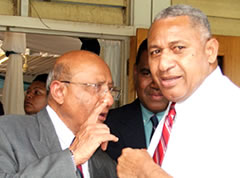
Interim Prime Minister and Minister for Finance, Commodore Frank Bainimarama presented a very bold budget to the nation today which has something for everyone - numerous concessions for the corporate sector, many infrastructure projects and some new initiatives to assist the disadvantaged.
The 2009 National Budget is aimed at increasing economic growth through investments and a number of incentives for businesses to lead the way in growth and creating employment opportunities.
This budget has the highest number of business incentives and concessions ever and include the biggest ever allocation for Fiji Visitors Bureau now known as Tourism Fiji.
While presenting next year's National Budget, Interim Prime Minister and Finance Minister, Commodore Frank Bainimarama said high priority has been given to infrastructure development, economic growth is projected to go in line to be pro-poor and the public sector to do more for less.
We start off with duties and taxes - what is going up or down:
For those who earn 15,000 dollars or less, the income tax threshold remains at 15,000 dollars which means that in 2009 these people will not pay any Income Tax or PAYE. The income tax threshold will remain the same for 2010.
The Government will revert to normal duty rates as follows, motor spirits or unleaded fuel from 34 cents to 44 cents per litre, diesel from 9 cents to 18 cents per litre and pre-mix outboard fuel from 17 cents to 27 cents per litre. Commodore Bainimarama new domestic retail price will be effective from 1st December 2008 and it is expected to be lower based on the reduction in the current world oil prices.
Government has maintained the concessions on basic food items like rice, oil and tinned fish which was put in place in June this year.
There is also a reduction in fiscal duty from 5% to 0% on full cream powdered milk in bulk, liquid milk in bulk and bulk butter.
The price of imported chicken will increase as fiscal duty of chicken has increased from 15% to 32% next year.
For LPG vehicles, mainly taxi drivers. There is good news as the fiscal duty has been reduced from 27% or 60% of specific rates whichever is the greater to 0%, which means that the price of LPG powered vehicles will drop.
Prices of Mobile Phones will increase as fiscal duty has gone up from 15% to 32%.
Export duty on unprocessed fish - A duty of 3% will be levied on export of unprocessed fish.
Export duty on timber - Duty of 3% will be levied on raw and unprocessed timber.
Bus Industry - Free fiscal duty on ticketing machines and ticketing machine parts and free import excise duty on ticketing machines and ticketing machine parts.
The fiscal duty on all items under the 27% duty ban will now be raised to 32% with immediate effect. These are imported items which are also manufactured locally. This duty ban has been applied to protect the local industry. The items include noodles, bottled water, biscuits, certain garments and footwear, canned foods which are imported, imported cigarettes and alcohol. So this basically means that the government has come out and increased the duty by 5 percent on imported items to protect our local businesses which are manufacturing similar items.
There is an increase in fiscal duty on multi wick kerosene stoves and spare parts from 5% to 32 %. Duty will also be increased on Golf cars and similar vehicles from 15% to 32%.
In 2009 the company tax or corporate rate will be reduced to 29 percent and then further reduced to 28 percent in 2010. The corporate tax currently stands at 31 percent.
There will also be an establishment of tax free regions, as Bainimarama said that the economically depressed Northern and Maritime Island region are in need of special consideration and assistance.
To encourage investment, support development and create employment opportunities in the North and the Maritime Islands, Government will declare Vanua Levu, Rotuma, Kadavu, Taveuni, Levuka, Lomaiviti, Kioa, Rabi and Lau, as tax free regions effective from 1st January 2009.
The Tax Free Regions incentive will include 13 years tax holiday for a new company and import duty exemption on raw materials, machinery and equipment for initial set-up.
In addition companies that start new projects with at least 25 percent equity participation involving indigenous Fijians will be granted an additional 5 year tax holiday. That is a total tax free status of 18 years. Bainimarama said such incentives should be provided to new companies investing at least $2 million.
The tourism industry has also received their biggest budget of 23.5 million dollars and a number of incentives have also been offered to the hotel and tourism industry.
There are new taxes - including a water resource tax and a road user levy.
There will be a Water Resource Tax levied on extract of water in its natural state which will be monitored on amount extracted from various water bottling companies around the country.
The Interim government targets to collect around $1.5 million from the water resource tax which will be in from January 1st next year.
FIRCA CEO Jitoko Tikolevu said this will only apply to those company who extract mineral water.
Interim Attorney General Aiyaz Sayed-Khaiyum also stressed that the tax was introduced after extensive consultations with stakeholders in the water bottling industry in Fiji.
The water resource tax will see anyone extracting under 5 million litres of water per month 0.11 cents per litre, over 5 million but under 10 million will be charged 0.22cents per litre, and 10million litres above will be charged 0.33 cents per litre.
Road user levy will be introduced to improve road conditions by vehicle category and classification. No further details have been given but the new Road User Levy will come into effect from January 1st next year.
The 2009 National Budget stands at 1.715 billion dollars compared to 1.2 billion dollars this year. Bainimarama said the increase in the budget is necessary to bring about incentives and provide assistance to businesses and those who are less fortunate.
The 2009 budget is pro growth and pro poor according to Commodore Bainimarama.
For the first time ever, a formalised monitoring system will be put in place to ensure that capital projects are completed. Commodore Bainimarama said they will emphasise the timely implementation of capital projects. In that regard, Bainimarama will shortly convene a capital projects workshop for senior servants in key agencies to ensure a satisfactory state of project readiness so that projects can start in January next year.
A number of road projects will also commence soon according to Commodore Bainimarama.
He said the interim government has also allocated funds to complete the Rotuma airstrip to facilitate the landing of ATR 42's and the upgrade of Matuku airstrip.
For the first time ever, the government has also come out with a concrete plan for Fiji's mahogany industry working on a government and landowner partnership.
A new education initiative announced by the Interim Government will offer some relief for the poorest of the poor families who are facing extreme difficulties in paying for their children's school fees.
On to budget allocations for the ministries:
The Education Budget is $271 million in 2009.
FIT's operating grant has been given $9 million, which is an increase of $1 million from this year, USP's Operating grant has been given $38.05 million, an increase of over $2million.
University of Fiji allocated $2 million which is $200,000 more from this year.
FIT's Capital grant allocated $6 million for Nadi School of Tourism and Hospitality.
There has been a significant increase in the budget of Public Utilities and Energy Ministry from 102 million to 151 million
next year.
Twenty million dollars for Suva/Nausori Regional Water supply
and other rural water supply $3.5 million has been set aside.
Seven million has been allocated for Nadi-Lautoka regional water supply. For rural electrification project $7 million 795 thousand has been set aside. Three million dollars has been allocated for
Somosomo Hydro Power project.
The budget for Urban and regional water supply has been increased from $56 million to $61 million.
We can expect better health facilities as the Health Ministry's Budget received $158.3 million for 2009.
A total of $3.3 million for upgrades and maintenance of urban hospitals. $1.3 million for maintenance of Health centers and nursing stations. A total of $550,000 will be spend on Equipment for health centers and Nursing stations.
$500,000 has been set aside for HIV/AIDS prevention and control programme.
The budget for military (RFMF) has been increased from $81.5 to $94.3 million. Police also had a increase in their budget allocation from $72.8m to $76.38m.
For family assistance, $20 million has been allocated. For Womans plan for action $350,000 has been set aside and $100,000 allocated for non-governmental organisations as grants.
One million dollars has been allocated to Public Rental Board subsidy, two million dollars will be spent on Squatter re-settlement and $1 million for HART.
Five million dollars has been allocated for the Sugar Industry Support Programme, $700,000 for contribution towards the Sugar Research Institute of Fiji.
The Elections Office has been allocated total of $5 million to prepare for upcoming general elections. This will include $3 million for voter registration exercise.
FICAC has been allocated $5.4 million.
The Former Finance Minister Mahendra Chaudhry said it is now a waiting game as Interim Prime Minister Commodore Frank Bainimarama announced large concessions in the budget.
He adds we will now have to wait and see whether these concessions will generate revenue and whether this level will be sustained.
The Interim Attorney General Aiyaz Saiyed-Khaiyum has stressed that the major incentives offered to try and increase investments in the North and other islands are for industries which are non-existent at the moment.
While clarifying the reasons for offering such incentives, Sayed Khaiyum said these are methods to try and attract investments into these areas.
FIRCA CEO Jitoko Tikolevu also stressed that they hope to start reaping the benefits of these incentives and various tax holidays from 2010.
Meanwhile, the Fiji Chamber of Commerce Acting President Swani Maharaj said while tax free exemptions are the way forward to generate investment in the country, it remains to be seen where the interim government will get their income from.
Meanwhile, a new education initiative announced by the Interim Government will offer some relief for the poorest of the poor families who are facing extreme difficulties in paying for their children's school fees.
Interim Education Minister, Filipe Bole said the new Poverty Relief Fund has been allocated $200,000 to implement this initiative and will be handled by the PM's office.
Bainimarama said it is anticipated that the bulk of funding for this initiative will come from the private sector, individuals, community and voluntary organisations and aid donors. To encourage such funding support, a 200 percent tax deduction for contributions in excess of $50,000 will be available.
Fiji Taxi Union General Secretary Rishi Ram has commended the fiscal duty reduction on LPG vehicles from 27% or 60% of specific rates whichever is greater to zero announced in the Budget.
Interim Minister for Lands, Netani Sukanaivalu said the $8.5 million incentives for land owners for the development of land and re-leasing of their land that have expired, is a positive sign.
Similar sentiments are made by Fiji Kava Council Chairman Ratu Josateki Nawalowalo on the land incentive.
Fiji Visitors Bureau Chairman Patrick Wong said they are happy with their $23.5million allocation adding they will now continue their branding work of Fiji overseas and widen their advertising market as not all countries have been affected by the global economic crisis.
Businessman, Hari Punja said while he is happy with the decrease in corporate tax from 31% to 29% for next year, he adds the budget delivery was very vague and he needs to look at which items duties have been increased or decreased.
While it has been confirmed that the National Council for Building a Better Fiji will be disbanded next month, an allocation of $402,000 has been made to the Prime Minister’s Office for work to continue on the Peoples Charter for next year.
Interim Attorney General Aiyaz Sayed Khaiyum revealed that the money has been set aside to implement recommendations when the charter is finalized.
However when questioned Permanent Secretary for Finance Peceli Vocea could not confirm how much has been spent so far on the NCBBF and on work on the draft Charter as they are awaiting final figures from the PM's Office.
Meanwhile, Former Prime Minister Laisenia Qarase has opted to comment after he analyses the budget.